Guide
Hard shell or soft side: what the choice actually changes
Polycarbonate against fabric, wheels against weight, and what an airline owes you when the case comes back broken.
The hard case against soft case argument is usually settled by looks. It is worth settling by use instead, because the two constructions fail in different ways and neither one is better in the abstract.
In this range 5 lines are hardside and 2 are softside, which is roughly the ratio in the wider market. What follows is what each one does with the same clothes inside.
What a polycarbonate shell is doing
Polycarbonate is the plastic used for safety glazing and headlamp lenses. It is chosen for luggage because it flexes under impact and returns, rather than cracking the way a rigid plastic does. Drop a loaded case on a corner and the shell dents inwards and springs back.
The texture on these shells is a functional choice rather than a decorative one. Ribbing breaks up a scuff so that the mark reads as one line in a pattern instead of a scratch on a flat panel. The first mark is inevitable. The texture decides whether you notice it.
What the shell cannot do is keep water out. The zip runs around the whole case and it is a fabric channel, not a seal. A hard case will keep an hour of rain off the contents while it sits on a trolley. It will not survive a puddle on a tarmac apron, and no case in this class claims otherwise.
The five-piece set in this range states a shell of polycarbonate and ABS rather than polycarbonate alone. ABS is stiffer and cheaper, and a blend of the two trades a little impact recovery for a little rigidity. The maker names the mix, and the page here repeats the words rather than translating them.
Hardside sets, most rated first
See all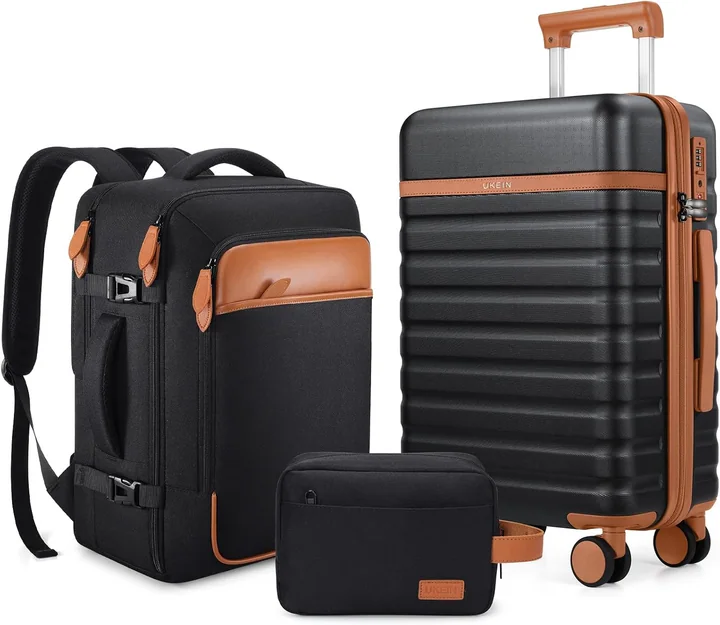

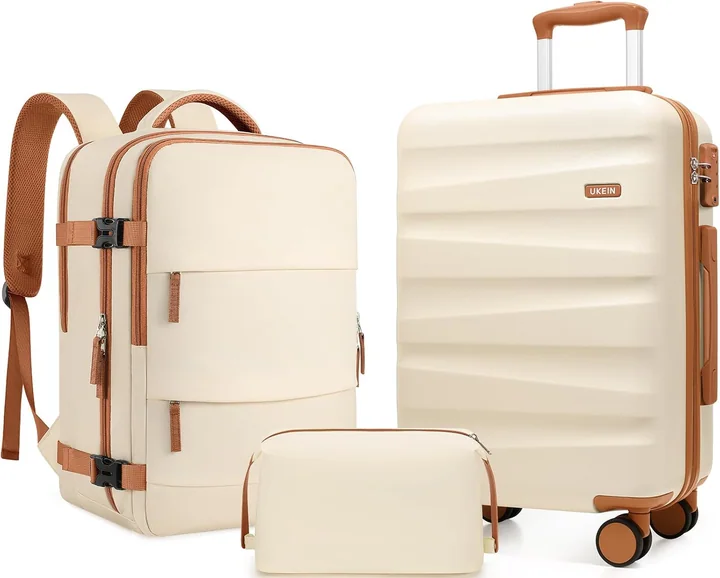
Luggage Set with Backpack, Hardshell Carry On Luggage Airline Approved
20" · 3 pieces 4.6 out of 5 (286) $69.99 - $79.99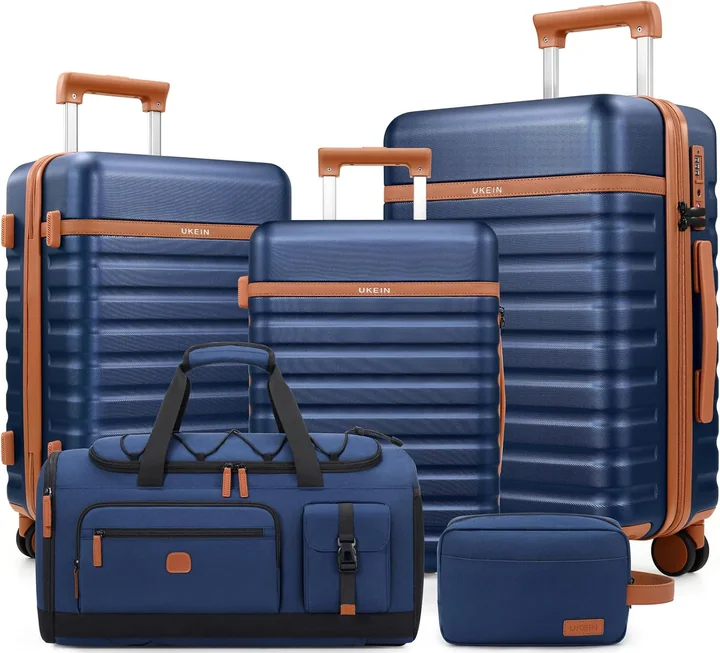
Luggage Sets 5Piece, Carry On Luggage Large Checked Suitcase Set
5 pieces 4.6 out of 5 (231) $129.98What fabric does that a shell cannot
A softside case has two advantages, and both of them appear at the end of a trip rather than at the start.
The first is give. Fabric absorbs an awkward shape. A pair of boots, a rolled coat and a bottle of wine go into a soft case in a way they do not go into a rigid box, because the fabric bulges and the shell does not.
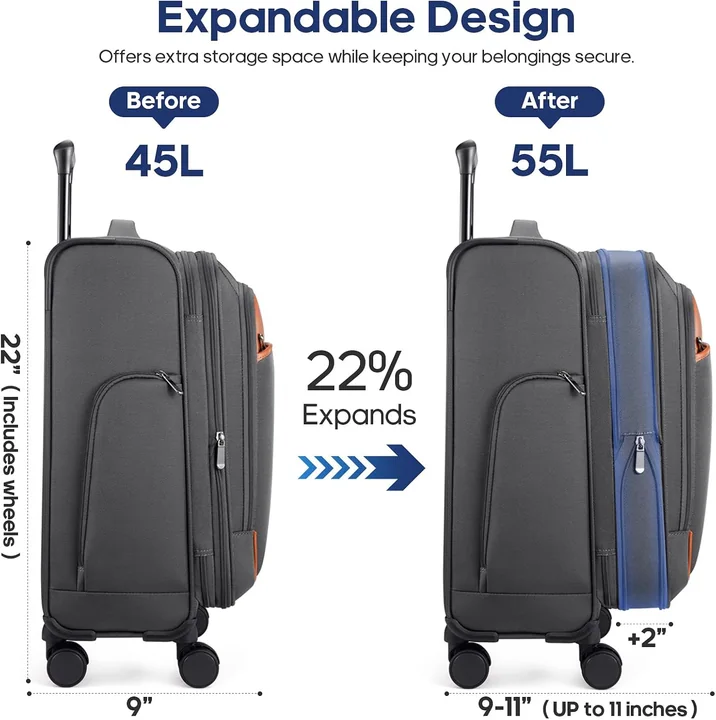
The second is expansion. The softside carry-on in this range states forty-five litres closed and fifty-five with the zip open, which is a quarter more space for the flight home. A hard shell cannot do this at all: the expansion zip on a hard case moves the two halves apart and the corners stop being square.
The costs are equally real. Fabric transmits pressure, so a stack of cases in a hold presses on what is inside rather than on the case. Fabric absorbs water rather than shedding it. And an outside pocket, which is the reason many people buy soft luggage, is the easiest thing on any bag to open without your knowledge.
Softside carry-on
See all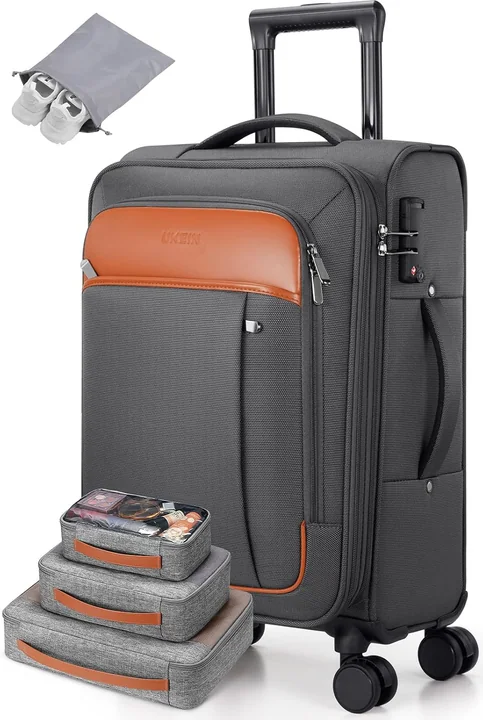
Expandable Carry On Luggage 22x14x9 Airline Approved, 20Inch Softside Carry On
20" · 45–55 L 4.5 out of 5 (161) $69.99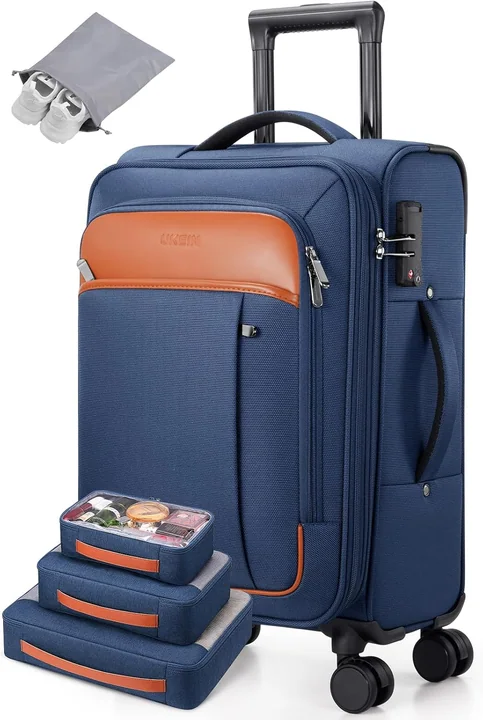
Softside Expandable Carry On Luggage 22x14x9 Airline Approved
20" · 45–55 L 4.5 out of 5 (161) $86.33The weight penalty, measured
Hard cases are usually heavier than soft cases of the same volume, and the gap is smaller than the argument suggests. Across this range the empty weights run from about two and a half pounds for a duffel to eleven pounds for a large checked case.
Eleven pounds of case out of a fifty pound allowance is twenty-two per cent of the allowance spent before anything is packed. That is the number worth carrying into the shop, and it is the same number that makes a two-pound difference between cases matter more than it sounds.
The weight is not wasted, though. It is spinner wheels, a telescoping handle, a lock, corner bumpers and a lining. A case that weighs nothing has none of those, and the reason to buy a case rather than a bag is precisely that list.
Wheels, and the part that fails first
Wheels are where luggage dies. Not shells, not zips, not handles: wheels. They are the only part in continuous contact with the ground and the only part that takes a kerb at speed.
Every wheeled case in this range uses dual spinner wheels that rotate through a full circle. Spinners roll upright beside you and take no weight on your arm, and that is how they took over the market. In exchange they are slower on a rough pavement than two large inline wheels, and they are the part that will need replacing first.
A practical habit extends their life more than any specification. On a cobbled street or a gravel path, tilt the case and pull it on two wheels. Spinner castors are built for a smooth floor, and pushing four of them across broken stone is what shears an axle.
The handle is the second failure point and the easier one to check in a shop. A three-stage aluminium handle should stop cleanly at each stage and have almost no side-to-side play. A handle that rattles when new will rattle louder in a year.
| Feature the maker names | Lines that carry it |
|---|---|
| Airline approved | 3 |
| Changing pad | 1 |
| Expandable | 2 |
| Laptop pocket | 2 |
| Packing set | 2 |
| Shoe compartment | 3 |
| Spinner wheels | 7 |
| TSA lock | 7 |
| Telescoping handle | 3 |
| USB port | 4 |
| Water resistant | 4 |
| Wet and dry pocket | 7 |
What a TSA lock is for
A TSA lock appears on 7 lines here, and it is the most misunderstood part of a suitcase. It is a combination lock with a keyway that security agents in the United States can open with a master key. The point is that they can open it without cutting it.
That is the whole benefit and it is worth having. A case selected for inspection with an ordinary padlock comes back with the padlock destroyed. A case with a TSA lock comes back locked and with a notice inside.
What it is not is security. A master-keyed lock is a lock with a documented bypass, and the zip beside it can be opened with a ballpoint pen and closed again by running the pull along the teeth. Treat a locked case as a deterrent against casual opening and nothing more. Passports, medication and electronics travel with you.
When the case comes back broken
Damage in the hold is not rare, and the rules on what an airline owes you are written down. For domestic flights in the United States the floor is set in federal regulation:
an air carrier shall not limit its liability for provable direct or consequential damages resulting from the disappearance of, damage to, or delay in delivery of a passenger's personal property, including baggage, in its custody to an amount less than $4,700 for each passenger
U.S. Department of Transportation, 14 CFR 254.4, Domestic Baggage Liability: carrier liability
Two words in that sentence carry the weight. Provable means you have to show what was in the case and what it was worth, and the photograph before the flight is how you do it. And floor means the airline may offer more than the figure but may not contract out of it.
The practical steps are the same on every carrier. Report the damage before you leave the airport, get a reference number, and keep the tag. A claim opened at the baggage desk is a different animal from a claim opened by email three days later.
What no airline covers is normal wear. A scuffed shell, a scraped corner and a worn wheel are the cost of the case doing its job, and the textured finish on these shells exists to make the first two less visible.
Why a set is usually the cheaper way in
A set is one case, one backpack and one toiletry bag in the same trim. 5 of the 11 lines here are sold that way, and the arithmetic behind it is simple: the three pieces together cost less than a case and a backpack bought apart, and they are designed to travel as one object.
The mechanical part of that design is a sleeve stitched across the back of the backpack. It slides over the extended handle of the case, and the two pieces roll together through a terminal on the case's wheels. That is the whole trick, and it is the reason the backpack in a set is worth more than a spare backpack from a drawer.
The limit of a set is that you are buying three things to get one. If the case is what you need and the backpack will sit unused, a single case is the honest purchase. The carry-on pages here list the single cases without the set.
Twenty inch cases, most rated first
See allLuggage Sets 3Piece, Carry On Luggage 20in Suitcase Set With Backpack
20" · 3 pieces 4.6 out of 5 (2,666) $79.99 - $89.99Luggage Set with Backpack, Hardshell Carry On Luggage Airline Approved
20" · 3 pieces 4.6 out of 5 (286) $69.99 - $79.99Expandable Carry On Luggage 22x14x9 Airline Approved, 20Inch Softside Carry On
20" · 45–55 L 4.5 out of 5 (161) $69.99Zips, the part nobody inspects
A case fails at the zip more often than at the shell, and the zip is the part buyers never test in a shop.
There are two constructions. A coil zip is a continuous spiral of nylon, light and flexible, and it self-heals: force it apart and running the slider back closes it again. A chain zip has separate metal teeth, is stronger against a straight pull, and does not recover once a tooth is bent.
Luggage almost always uses coil, because a case is a curved object and a chain does not like corners. The alloy the maker names is the slider and the pull rather than the teeth, and that is where the weight and the feel come from.
What kills a coil zip is not force on the slider. It is packing past the closure line so that the two halves have to be pulled together while the slider travels. Do that a dozen times and the coil splays at the corner where the pressure is highest.
The test in a shop takes ten seconds. Close the empty case, then run the slider around all four corners twice. It should not need a second hand at any point. The corners are where a poor zip binds, and an empty case is the easiest condition it will ever face.
Handles, and the play you can accept
The telescoping handle is the most complicated mechanism on a suitcase and the least repairable. It is two or three nested aluminium tubes, a locking button, and a housing screwed into the shell.
Three stages rather than two is the specification worth having, and these cases state three. Stages set the height, and a handle with three positions fits a tall traveller and a short one without either of them stooping. A two-stage handle is a compromise chosen for cost.
Side-to-side play is the number to judge. Extend the handle fully, hold the top and push. Half an inch of movement at the grip is normal on any case in this price class. An inch means the tubes are loose in the housing, and that gets worse rather than better.
The habit that preserves a handle is dull and works. Push it all the way down before the case goes anywhere it will be stacked or thrown, and never pull the case sideways by the extended handle to lift it into a car. Lift by the side grip, which is the handle designed for it.
Cases with a three-stage handle
See allLuggage Sets 3Piece, Carry On Luggage 20in Suitcase Set With Backpack
20" · 3 pieces 4.6 out of 5 (2,666) $79.99 - $89.99Luggage Set with Backpack, Hardshell Carry On Luggage Airline Approved
20" · 3 pieces 4.6 out of 5 (286) $69.99 - $79.99Luggage Sets 5Piece, Carry On Luggage Large Checked Suitcase Set
5 pieces 4.6 out of 5 (231) $129.98What the inside of a case is for
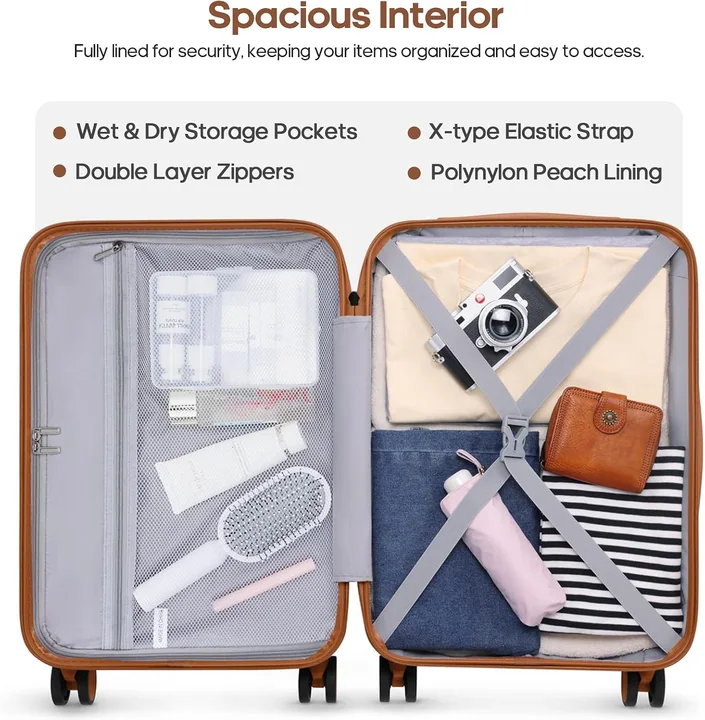
Interiors look like a feature list and behave like a system. A case with a divider panel on one side and cross straps on the other is doing two different jobs at once.
The strap side holds a pile still. Rolled clothes under tension do not shift, and shifting is what creases them. The panel side separates: shoes, a wash bag, cables and anything that should not touch a clean shirt go behind a zip.
The mesh pockets on the panel are not extra storage in any useful sense. They are for flat, light things that would otherwise slide to the bottom: socks, a charger, a passport wallet on the way out. Filling them with heavy items unbalances the half they are attached to.
The dry and wet pocket is the one interior feature that changes a trip rather than tidying it. A wet swimsuit in a lined pocket is a swimsuit. A wet swimsuit in a plastic bag among clothes is a smell in the case for a week.
None of that requires packing cubes. Cubes are a way of buying the same separation in a case that does not have it, and in a case that does they mostly add weight.
Cleaning and storing a case between trips
A case spends fifty weeks of the year in a cupboard, and most of the damage people blame on travel happens during those fifty weeks.
Clean the outside with a damp cloth and nothing else. Solvents craze polycarbonate, which means a network of fine cracks that never comes out and that starts at the corner you cleaned. Marks from a conveyor belt come off with water and patience.
Clean the wheels properly once a year. Grit works into a castor and grinds the bearing flat, and the noise a worn castor makes is the sound of that grinding. A cocktail stick and two minutes per wheel is the whole job.
Store the case open and empty. A closed case holds whatever moisture was in it when you put it away, and the lining is where that ends up. A case put away damp after a rainy trip smells of that trip for a year.
Nesting is fine and is the point of a five piece set. Both cases have to be dry, both have to be open, and nothing should be left inside the small one, however convenient it seems in August.
How long a case should last, and what fails first
A case in this class, used for four or five trips a year and cared for as above, has four to six years in it. The failures come in a predictable order.
- Wheels first. They are consumable, and on many cases they are replaceable with a screwdriver and a matched castor.
- Then the handle. Play becomes a rattle, the rattle becomes a stage that does not lock, and this is usually the end.
- Then the zip at one corner. A coil that has splayed can sometimes be re-seated by running the slider back past it, once.
- The shell almost never fails. It scuffs, it dents, it goes on working. A cracked shell means an impact that would have destroyed the contents of a soft bag.
That order is the argument for buying a case with good wheels and a solid handle rather than a thicker shell. The shell is the part that is already good enough.
The backpack in a set, judged on its own
A set is only as good as the piece you would not have bought separately, and in these sets that is the backpack.
Three things make a travel backpack different from a school one. A flat back panel with a padded sleeve, so a laptop sits against your spine rather than against a water bottle. A luggage sleeve across the back, so the bag rides on the case handle. And a clamshell opening, so the bag lies flat and packs like a small case instead of a sack loaded from the top.
The backpacks in this range state a forty litre volume and a padded compartment, and the softside carry-on states a laptop pocket sized for fifteen to seventeen inch machines. Forty litres is at the upper end of what airlines accept as a personal item, and a bag at that size has to be packed loosely to go under a seat.
What these backpacks are not is a hiking pack. There is no hip belt, so the weight sits on your shoulders rather than your hips, and forty litres of weight on shoulders is uncomfortable after twenty minutes. For an airport that is fine. For a day of walking it is not.
Backpacks and soft bags
See all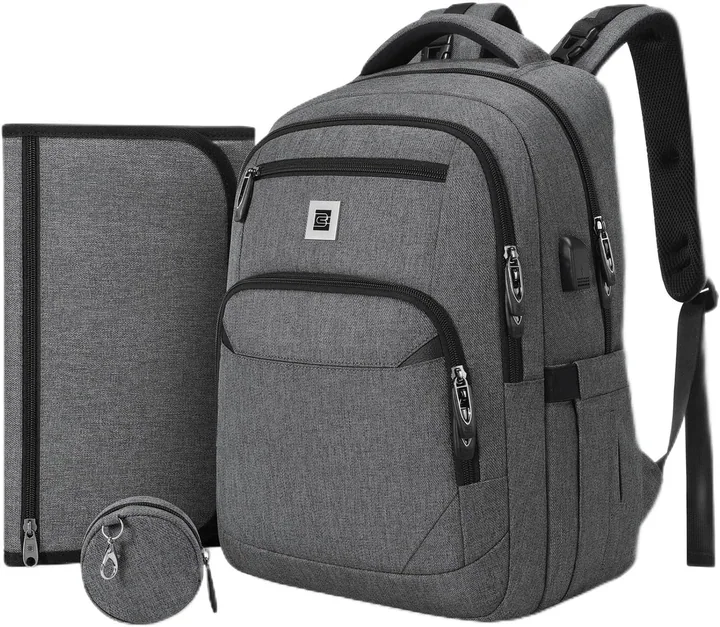
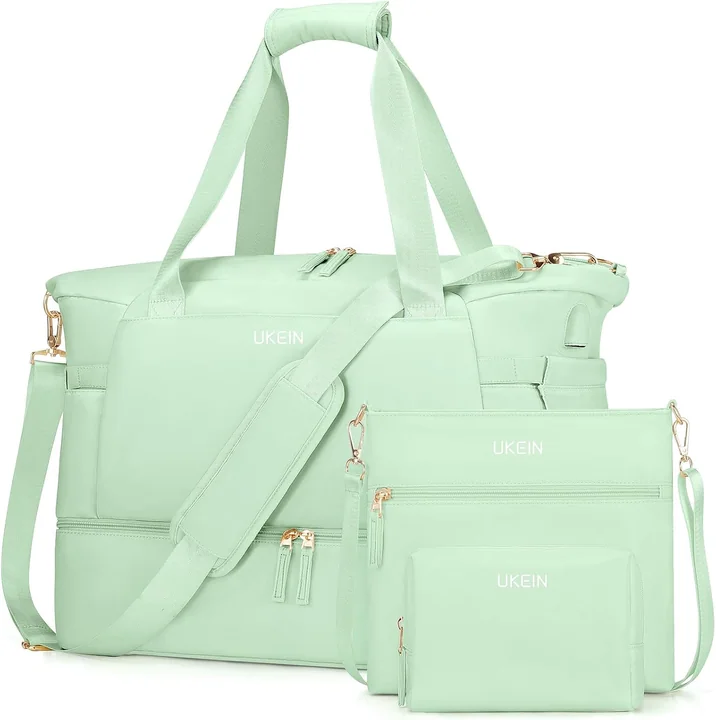
Travelling Bags, Travel Backpack Bag for Women with USB Charging Port & Shoe
4.5 out of 5 (75) $19.99 - $29.99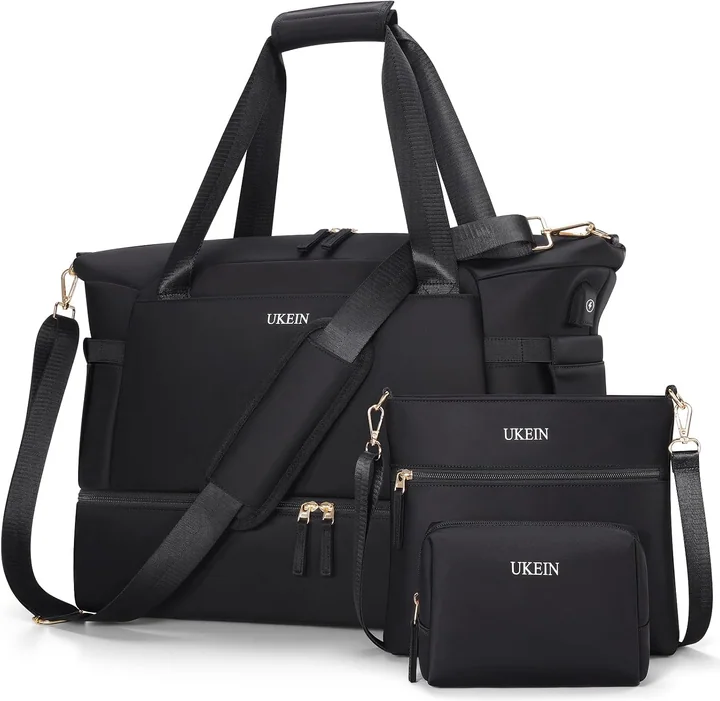
Travel Duffel Bag for Women, Gym Backpack Bag for Women with USB Charging Port
3 pieces 4.5 out of 5 (75) $19.99 - $29.99What the price is buying at this level
The lines here run from $19.99 for a soft bag to the low three figures for a five piece set. It is worth being plain about what that money does and does not buy.
It buys a polycarbonate shell rather than a polypropylene one, four spinner wheels rather than two inline ones, a three-stage handle, a TSA lock and a lined interior with a divider. Ten years ago that specification was a luxury case.
It does not buy a hinged frame, an aluminium body, sealed bearings or a lifetime warranty programme. Cases with those exist at four to ten times the price, and the difference shows up after ten years rather than after two.
The honest way to read the difference is per trip. A case at this level used four times a year for five years costs a few dollars a trip. That number, rather than the shelf price, is the one worth comparing between a set and a single case.
What actually happens to a case in the hold
Most opinions about luggage construction come from a shop floor. The relevant environment is a baggage system, and it is worth describing because it explains every design decision on a case.
A checked case is dropped onto a belt and carried up an incline. A diverter arm pushes it sideways at speed. It falls into a cart, crosses an apron in whatever weather there is, and goes into a hold where other cases are stacked on top of it. On arrival the sequence runs backwards.
Three forces come out of that. Impact, which is the drop and the diverter, and which a flexible shell handles better than a rigid one. Compression, which is the stack, and which a hard case resists and a soft case passes on to its contents. And abrasion, which is the belt, and which leaves the underside of every case that has flown scuffed.
The corner bumpers these cases state exist for the first of those. A corner is where a dropped case lands, and a bumper is a sacrificial pad that takes the scrape instead of the shell.
Nothing in that sequence is unusual or careless. It is a system moving thousands of bags an hour, and a case is designed to survive it rather than to be spared it.
Colour, scuffing and what a textured shell hides
A pale case shows its first mark sooner than a dark one, and a smooth shell shows it more clearly than a ribbed one. Both facts are visible rather than structural, and both are worth knowing before choosing.
Ribbing works by breaking a straight scuff into short segments that read as part of the pattern. On a flat panel the same scrape is one continuous line and the eye follows it. The cases here are ribbed for that reason and not only for looks.
Cream and beige hide dust and show scrapes. Black hides scrapes and shows dust and every fingerprint on a matte finish. Mid greens and navies are the compromise, and they are also the easiest to find on a carousel.
A scuff on polycarbonate is usually transferred material rather than removed shell: rubber from a belt, paint from a cart. A damp cloth takes most of it off, and a magic eraser sponge takes the rest at the cost of dulling the finish where it is used.
Choosing, in three questions
- Does it go in the hold? If yes, a hard shell earns its weight. If it stays with you in the cabin, the fabric case is lighter and takes the awkward shape.
- Does the trip home carry more than the trip out? If yes, expansion matters and only a soft case has it.
- Is anything inside fragile? If yes, nothing in this class is enough on its own. Wrap it in clothes in the middle of the case, or carry it.
None of those questions is about looks, which is the one thing everybody decides first. Pick the construction from the questions and the colour afterwards.
Two guides here carry the rest of the decision. The size guide covers what fits in a cabin case and what the gate measures, and the packing guide covers what goes inside once the case is chosen.
Sources we read
| Source | Published by | Read |
|---|---|---|
| 14 CFR 254.4, Domestic Baggage Liability: carrier liability | U.S. Department of Transportation | 5 September 2026 |